BREAKING NEWS — Chief Justice John Roberts has temporarily allowed construction of President Donald Trump’s $400 million White House ballroom project to continue while the Supreme Court considers an emergency appeal from the administration.
The temporary order prevents a lower-court injunction from taking effect while the justices review the case.
It is not a final ruling on whether Trump has the authority to complete the project without congressional approval.
What Chief Justice Roberts Decided
Roberts issued an administrative stay Friday allowing construction to continue temporarily.
The chief justice handles emergency applications originating from the federal appeals court in Washington. He can act alone on a short-term administrative matter before referring the larger request to the full Supreme Court.
The order gives the justices additional time to consider whether the lower-court injunction should remain suspended throughout the administration’s appeal.
The Supreme Court’s emergency case is listed as application 26A203.
Lower Courts Said Congress Must Approve the Project
A federal district judge previously ordered the administration to stop aboveground construction of the ballroom. The judge allowed underground work involving bunkers, military installations and other security facilities to continue.
A divided panel of the U.S. Court of Appeals for the District of Columbia Circuit later upheld the restriction.
The appeals court concluded that the president could not unilaterally proceed with the massive construction project without congressional authorization.
The majority wrote that the decision was “for Congress to decide” and was not a matter for “Executive self-help.”
That ruling was scheduled to take effect Friday unless the Supreme Court intervened.
Roberts’ temporary order means the aboveground work may continue for now.
The Trump Administration Cites National Security
The Trump administration argues that the president has broad authority to renovate the White House and other federal buildings.
Government lawyers have also said completing the ballroom structure is necessary because it is integrated with underground national-security facilities.
When the ballroom was initially announced, the administration emphasized its use for state dinners and other large events. Trump also said it would be funded through private donations, including money from himself.
The administration has increasingly emphasized security concerns during the legal battle.
Solicitor General D. John Sauer called the lower-court decision “extraordinary and unlawful” and argued that completing the project is vital to national security.
Preservation Group Challenges Trump’s Authority
The National Trust for Historic Preservation filed the lawsuit challenging the project.
The organization argues that Trump does not have the unilateral authority to demolish the historic East Wing and build a 90,000-square-foot ballroom without approval from Congress.
The group has also accused the administration of attempting to complete construction faster than the courts can review its legality.
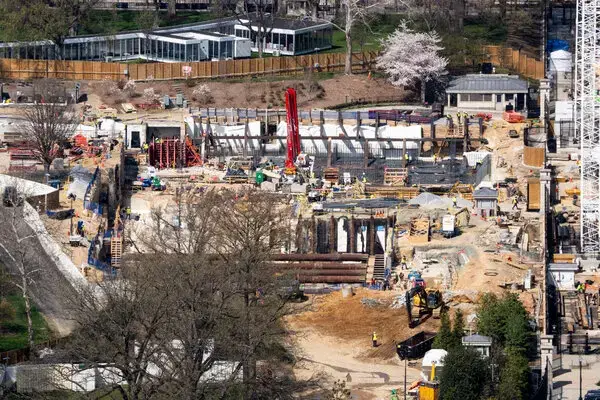
According to The Associated Press, the administration says approximately 65% of the project has already been completed. About $200 million in private donations has reportedly been spent or committed.
Construction crews have been working as many as 20 hours per day, seven days a week.
This Is Not the Supreme Court’s Final Decision
Roberts’ order does not overturn the lower court’s legal conclusion.
It also does not establish that Trump can complete the ballroom without congressional approval.
The order simply maintains the current construction schedule while the Supreme Court decides what to do with the administration’s emergency appeal.
The full court could allow construction to continue throughout the appeal, reinstate the lower-court injunction or issue another order establishing different limitations.
For now, construction continues and the larger constitutional question remains unresolved.